DCF887: the same number, two different tools on paper
The DCF887 is a 152 ft-lb impact driver, not a 1,825 ft-lb tool. The confusion comes from copying the right number, 1,825, and attaching the wrong unit label.
| Spec label | What it says on paper | Converted value | What class of tool it describes |
|---|---|---|---|
| DCF887, correct label | 1,825 in-lbs | 152 ft-lbs | 1/4-inch impact driver |
| DCF887, wrong label | 1,825 ft-lbs | 21,900 in-lbs | Wrong unit on the DCF887 spec |
| DEWALT 20V MAX XR 1/2-in High Torque Impact Wrench | 1,030 ft-lbs fastening torque | 12,360 in-lbs | 1/2-inch high-torque impact wrench |
The audit is simple: divide inch-pounds by 12 to get foot-pounds.
1,825 in-lbs ÷ 12 = 152.08 ft-lbs
Once you know that, 1,825 ft-lbs reads like an impact wrench number, not a compact DCF887 driver. A mislabeled DCF887 would outrank DEWALT’s 1/2-inch high-torque impact wrench by 795 ft-lbs on paper. That is not a close comparison; it turns a 152 ft-lb DCF887 into a claimed 1,825 ft-lb tool, a figure that even exceeds the 1,400 ft-lbs breakaway rating on DeWalt’s 1/2-inch high torque impact wrench.
Verdict: use in-lbs when comparing compact impact drivers, especially 1/4-inch hex models where the published numbers commonly sit in the four-digit inch-pound range. Use ft-lbs for tools whose published torque is already in foot-pounds, like the DeWalt DCF900 impact wrench at 1,030 ft-lbs fastening torque and 1,400 ft-lbs breakaway torque.
The trap is that both labels look familiar. A cleaner cross-check is the unit conversion itself: the DCF887 is listed at 1,825 in-lbs, and dividing by 12 gives about 152 ft-lbs, the same rating shown for the DCF887P1 kit.
The 12x mistake is not subtle once you do the math
| Reading the spec as... | Correct treatment | What it implies |
|---|---|---|
| inch-pounds | divide by 12 for foot-pounds | normal compact impact-driver territory |
| foot-pounds | no conversion applied | a 1/4-inch hex driver pretending to be a heavy impact wrench |
To compare it with tools rated in foot-pounds, divide the inch-pound value by the number of inches in a foot:
manufacturer in-lb rating ÷ 12 = ft-lb equivalent
That lands the DCF887 at roughly 152 ft-lbs, allowing for rounding. Read the same digits as foot-pounds and the chart has not found extra torque.
The false version is not a little optimistic. It multiplies the intended torque class by twelve. In newton-metres, the bad foot-pound reading would also explode: each pound-foot equals 1.3558179483314003 Nm, so a four-digit ft-lb claim would imply a four-digit Nm tool as well. That figure belongs in impact wrench territory: DeWalt’s 1/2-inch high-torque models are rated at 1,030 ft-lbs fastening and 1,400 ft-lbs breakaway, and the gap is large enough that a driver spec wearing wrench units should look wrong on sight.
A better separator is tool class: the DCF887 is a compact 1/4-inch driver, 5.3 inches front to back, built to spin fast at up to 3,250 RPM and 3,600 impacts per minute, while DeWalt’s high-torque 1/2-inch wrench sits in a different lane entirely with 1,030 ft-lbs fastening and 1,400 ft-lbs breakaway. Foot-pounds only win after conversion, or when the tool category is already rated that way.

The fact check that catches the bad chart before it ships
| Check | In-lbs wins when… | Ft-lbs wins when… |
|---|---|---|
| DCF887 torque field | the chart is describing the published impact-driver torque spec | the inch-pound number has already been converted |
| Product category | the tool is a compact 1/4-inch impact driver | the comparison set is impact wrenches or another category sold that way |
| Bad-chart signal | the same digits appear beside the wrong unit | the converted number matches the original unit math |
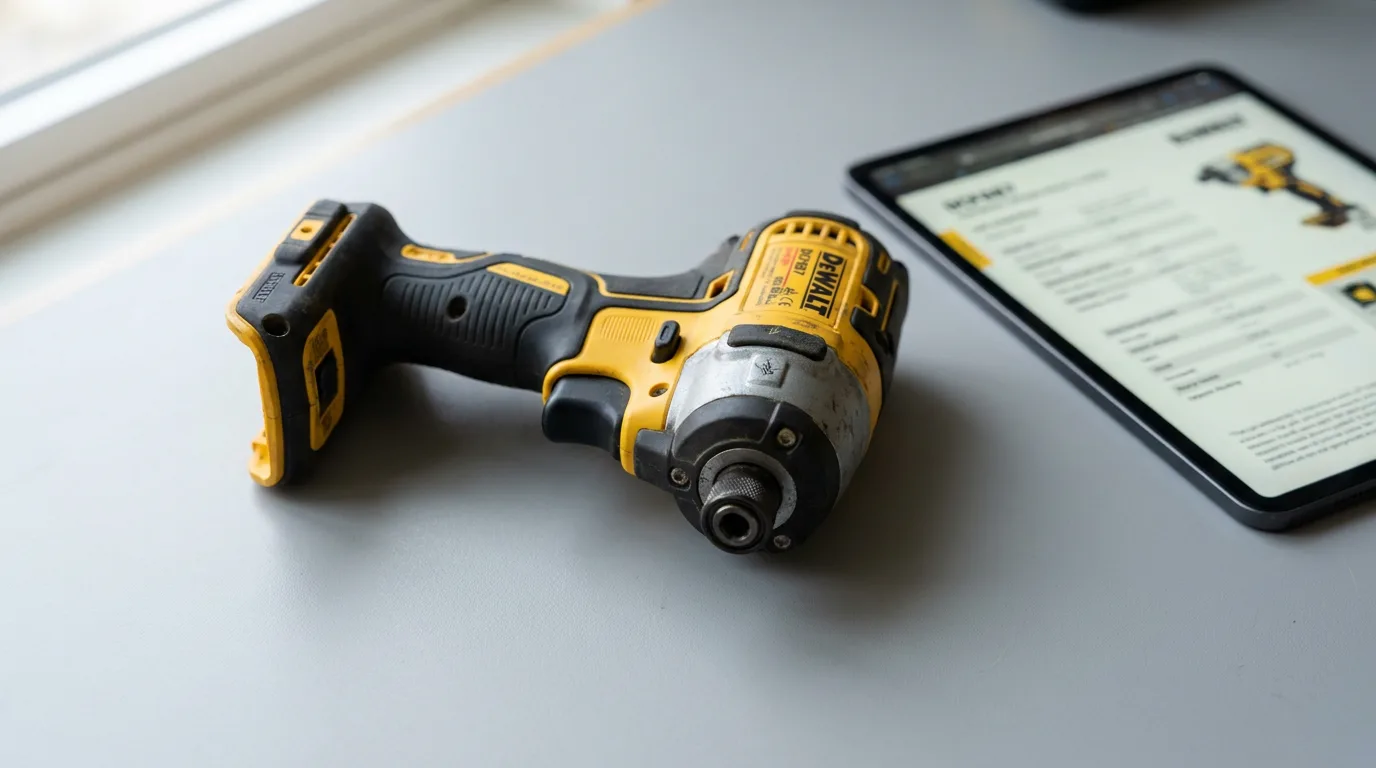
The audit starts with identity, not torque. Confirm the model first: DeWalt DCF887, 20V MAX XR, 1/4-inch hex, 3-speed impact driver. Its top operating figures are 3,250 RPM and 3,600 impacts per minute. Those figures pin the spec sheet to the right tool before anyone argues over the torque cell.
Then sanity-check the label against the kind of tool this is: 152 ft-lbs is impact-driver territory, while four-digit ft-lb ratings belong to high-torque 1/2-inch impact wrenches such as DeWalt’s DCF900, rated at 1,030 ft-lbs fastening and 1,400 ft-lbs breakaway. The DCF887 has three speed modes.
| Mode | Published max torque |
|---|---|
| Mode 1 | 240 in-lbs, 20 ft-lbs |
| Mode 2 | 1,500 in-lbs, 125 ft-lbs |
| Mode 3 | 1,825 in-lbs |
Mode 3 is the high-speed setting, topping out at 3,250 RPM on the DCF887. The unit beside it has to stay attached. Strip the unit off, paste the digits into a comparison database, and the error becomes easy to miss because the number still looks familiar.
It kept the 1,825 and swapped the unit. That is not a competing specification. That mistake doesn’t just bloat a spec sheet, it moves the DCF887 into the wrong product class, alongside high-torque 1/2-inch impact wrenches that are rated around 1,030 ft-lbs fastening and 1,400 ft-lbs breakaway.
A practical pre-publication check is short:
- Match the model name and drive size before reading the torque row.
- Pull the max-speed and impact-rate figures from DEWALT to confirm the tool family.
- Compare the torque row with the three-mode breakdown.
- Flag any chart where the Mode 3 digits appear beside foot-pounds without a conversion step.
- Hold the page until the unit is corrected.
The verdict is blunt. Use inch-pounds for the DCF887’s native spec and for impact-driver-to-impact-driver comparisons. Use foot-pounds only after conversion, or when the whole comparison set is already expressed in foot-pounds. The listing mistake matters beyond bragging rights: treating inch-pounds as foot-pounds applies a 12x torque load on paper, enough to turn a routine spec check into a bad fastening decision.
When inch-pounds wins, and when foot-pounds should take over
Use inch-pounds for impact-driver spec tables until the comparison crosses into impact wrenches. The DeWalt DCF887 belongs on the driver side of that line: 152 ft-lbs after conversion, not a four-digit ft-lb machine.
| Unit to use | Wins for | Why it works | Example check |
|---|---|---|---|
| Inch-pounds | Impact driver vs impact driver | Keeps the manufacturer’s native driver spec intact and avoids rounding small differences into mush | DeWalt’s own DCF887 figures compare cleanly once the units stay intact: 1,825 in-lbs is 152 ft-lbs, not 1,825 ft-lbs |
| Foot-pounds | Impact wrench vs impact wrench, or mixed driver/wrench tables | Matches the scale buyers expect for lug nuts, structural fasteners, and wrench classes | A true 1,825 ft-lb figure would put this far beyond the DCF887’s actual 152 ft-lbs after conversion |
| Converted foot-pounds | Driver included in a wrench-style chart | Makes the category gap visible without changing the tool’s identity | 2,500 in-lbs ÷ 12 = 208.3 ft-lbs |
The rule is mechanical: if the tool is a quarter-inch hex impact driver, print the native torque in inch-pounds first. If the table includes half-inch or three-eighths impact wrenches, convert the driver figure to foot-pounds and label it as a conversion. Do not carry the same digits across the unit column.
That last error is the expensive one. A buyer comparing that mislabeled DCF887 to DeWalt’s 1/2-inch high-torque impact wrench would think the driver’s torque is higher, when the real comparison is 152 ft-lb versus 1,030 ft-lb. It does not. A DCF900-class impact wrench sits around 1,030 ft-lbs of fastening torque, which is the right neighborhood for lug nuts and large anchors; the DCF887 is a compact 1/4-inch hex impact driver, 5.3 inches front to back, built for screws and smaller fasteners instead.
Foot-pounds belong on tools like DeWalt’s 1/2-inch high-torque impact wrench, the kind of machine rated at 1,030 ft-lbs fastening and 1,400 ft-lbs breakaway torque. Put that unit on a compact 1/4-inch driver spec and the chart stops describing the tool in your hand. Inch-pounds is the right unit for the DCF887’s 1,825 torque rating, and dividing by 12 gives the matching 152 ft-lb figure for like-for-like spec checks. Conversion is allowed. Unit laundering is not.
"But brands mix units all the time, so maybe 1,825 ft-lbs is just another convention"
| Case | What changes | What the DCF887 number should look like |
|---|---|---|
| Normal cross-unit spec | Unit and value both change | 1,825 in-lbs becomes 152 ft-lbs |
| Copy error | Unit changes, value does not | same digits, wrong label |
That objection is fair. Tool brands do mix inch-pounds, foot-pounds, and newton-metres across spec sheets, packaging, dealer pages, and comparison charts. A quarter-inch driver is often listed in inch-pounds because the number is easier to compare against other drivers. The DCF887 spec is stated in inch-pounds, not foot-pounds.
But that is conversion, not permission to keep the number unchanged. One foot-pound equals twelve inch-pounds, because the lever length has moved from one inch to one foot. A cleaner check is tool class: 1,825 belongs to the compact 1/4-inch DCF887 driver, while four-digit foot-pound numbers live on DeWalt’s high-torque 1/2-inch impact wrench line, where the DCF900 is rated at 1,030 ft-lbs fastening and 1,400 ft-lbs breakaway.
1,825 ÷ 12 = 152.08
A quick plausibility check catches the bad chart: the DCF900 is a different class of tool, rated at 1,030 ft-lbs fastening and 1,400 ft-lbs breakaway. The DCF887 is a 5.3-inch 1/4-inch hex driver that tops out at 3,250 RPM and 3,600 BPM, a very different tool class.
Key Takeaways
| Unit | Wins when | Loses when |
|---|---|---|
| In-lbs | You are comparing quarter-inch impact drivers from maker specs | The chart mixes drivers with torque wrenches |
| Ft-lbs | You need one chart across tool classes | The value was relabeled instead of converted |
For the DeWalt DCF887, treat inch-pounds as the native spec and foot-pounds as the translated spec. A four-digit foot-pound claim for this driver is not aggressive marketing; it is a unit failure.
By DeWalt’s own lineup, the scale is different: the DCF900 impact wrench is rated at 1,030 ft-lbs fastening torque and 1,400 ft-lbs breakaway torque, the territory where four-digit foot-pound claims actually live. DeWalt’s own high-torque 1/2-inch impact wrench sits at 1,030 ft-lbs fastening torque, which is why a DCF887 row showing the same order of magnitude should trigger an audit, not a comparison.
Frequently Asked Questions
Is the DeWalt DCF887 really 1,825 ft-lbs?
No. That corrected value also fits the class of tool: DeWalt’s own high-torque 1/2-inch impact wrench is rated at 1,030 ft-lbs fastening torque, so a compact 1/4-inch hex impact driver claiming 1,825 ft-lbs should look wrong on sight. A chart showing the same digits with a ft-lb label has changed the unit without doing the conversion.
How do you convert in-lbs to ft-lbs?
Divide the inch-pound value by 12. Keep the original unit visible while you check the math, because the most common chart failure is a copied number with a swapped label. If the digits stay unchanged after the unit changes, reject that row.
Should impact driver torque be listed in in-lbs or ft-lbs?
Use in-lbs when comparing quarter-inch impact drivers by manufacturer specs, and use ft-lbs only after recalculating the value. Inch-pounds keep normal impact-driver numbers easy to compare without rounding away detail. Foot-pounds work better when one table has to include larger tool classes.
Why does a wrong ft-lb label matter so much?
A wrong ft-lb label turns a normal impact-driver spec into a twelve-times claim. That does not make the tool stronger; it makes the comparison unusable. It can also push a buyer toward the wrong model if the chart is sorted by torque.
Does N.m help catch an in-lbs vs ft-lbs mistake?
Yes. Foot-pounds convert to Newton meters by multiplying by 1.356, so the corrected DCF887 value lands near 205 N.m. On the DCF887, the check is simpler: DeWalt lists 1,825 in-lbs and 152 ft-lbs for the same tool, so any chart that says 1,825 ft-lbs copied the number and dropped the unit conversion.
Are impact driver torque specs the same as torque wrench settings?
No. Impact driver torque specs are max-output comparison numbers, not precision fastening settings. A unit mistake on a torque wrench can be costly: setting 100 ft-lb when the job calls for 100 N.m is about 35% too much torque. A quick check against DeWalt’s own lineup keeps the comparison honest: the DCF887 is an impact driver, while the 1/2-inch high-torque impact wrench sits in the four-digit ft-lb range, up to 1,030 ft-lbs fastening and 1,400 ft-lbs breakaway.