
One Wrong Torque Conversion Can Wreck the Economics of Cheap AI Content
AI blog tools can cut drafting time by 50% to 90%, and that speed hides how easily unchecked copy becomes expensive draft debt. That is the trap. If an AI SEO blog writer turns inch-pounds into foot-pounds without checking the unit, the draft does not need a light edit. It needs an audit.
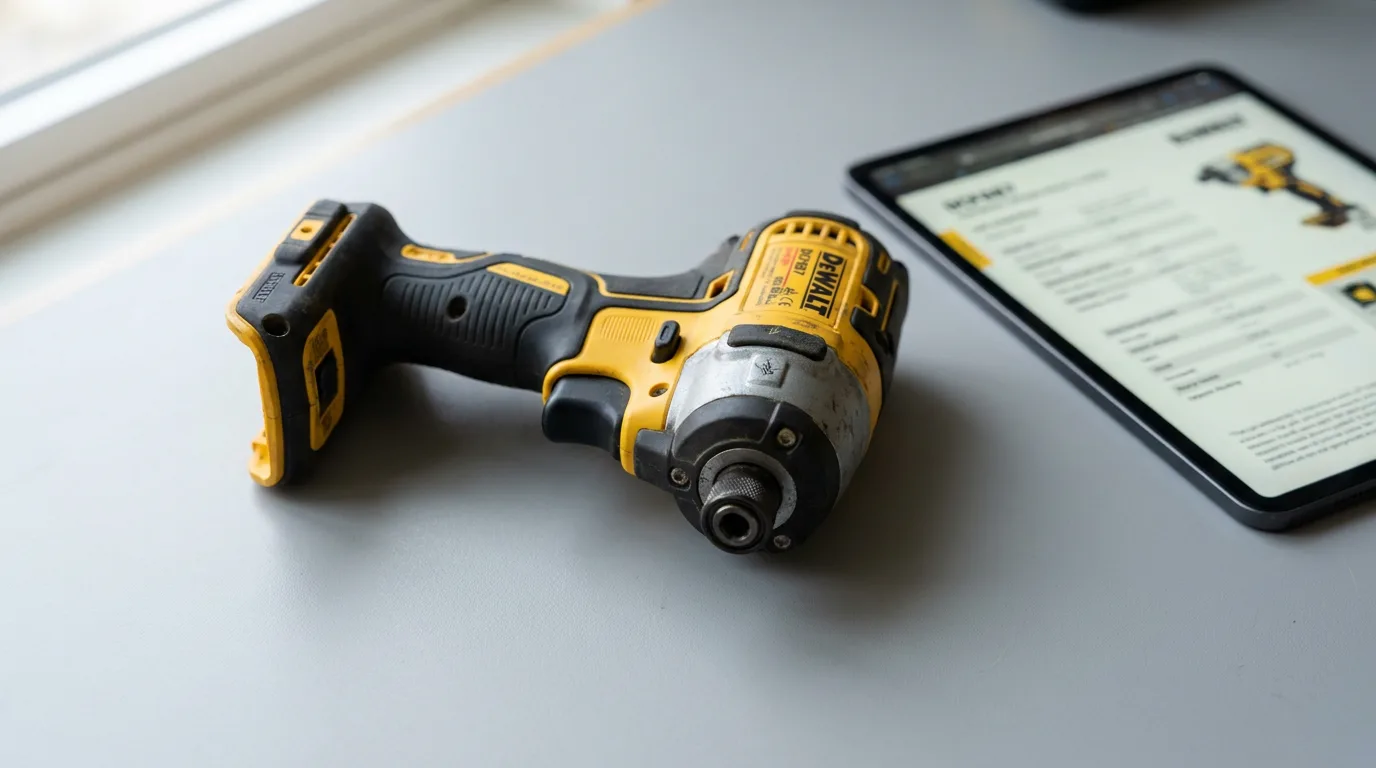
Take a unit conversion in a torque spec. Its torque figures are not decorative copy; they change what a reader believes the tool can do.
| DCF887 speed mode | Published torque | Correct conversion |
|---|---|---|
| Speed 1 | 240 in-lbs | — |
| Speed 2 | 1,500 in-lbs | — |
| Speed 3 | 1,825 in-lbs | — |
The calculation is ordinary:
1,825 in-lbs ÷ 12 = 152.1 ft-lbs
A generic model can still produce the sentence “the DCF887 delivers 1,825 ft-lbs of torque” because the phrase sounds plausible in isolation. It is a unit failure dressed up as product expertise.
That error is not just a typo in a blog post. It can contaminate a comparison table, a “best impact drivers” roundup, schema markup, internal links, and sales enablement copy copied from the article later. By the time an editor catches it, the cheap draft has already created work for the technical reviewer, SEO owner, and CMS manager. If no one catches it, the brand has published a spec claim that a knowledgeable buyer will reject immediately.
This is why technical brands should price unverified drafts as debt. A batch of low-cost posts may look like inventory on a content calendar, but every unsourced specification is a future correction ticket. BenchWrite’s claim is source-traced drafting, not prettier paragraphs. It limits the automation to drafting, where the time savings are real and the factual check still belongs before publication.

Cheap Drafts Are Only Cheap Until You Price the Audit
A cheap AI SEO blog writer can make drafting look almost free while moving the expensive work into review. Audit debt.
Start with the tempting math. One bulk plan prices at $28 for up to 40 articles, which is $0.70 per draft before any human labor. Another charges $99 for 5 articles, or $19.80 each. If the tool cuts blog writing time by 50% to 90%, the content calendar suddenly looks funded.
Now price the part the tool did not do.
| Workflow item | Cheap unverified draft | Source-grounded draft |
|---|---|---|
| Draft generation | Minutes | Minutes |
| Spec verification | Manual | Built into research |
| Unit checks | Manual | Checked before drafting |
| Editorial risk | Hidden | Priced upfront |
Automating only the drafting step saves about 55% to 60% of total production time. That leaves a large remainder: checking product specs, units, tables, claims, and internal consistency. Automating only the draft still leaves 40% to 45% of the work on the editor’s desk. Forty “cheap” drafts now carry $3,000 of audit labor before publishing.
BenchWrite prices the work differently: $29 for 250 Starter credits or $79 for 1,000 Growth credits, across multiple brands. The cost is not just text generation. It buys a workflow where the time savings stay in drafting, roughly 55% to 60%, while the editor spends that recovered time on argument, structure, and brand fit before publishing.

The Decision Line: When an AI SEO Blog Writer Needs Source Grounding, and When It Does Not
Use a source-grounded AI SEO blog writer the moment a page contains a number a buyer, technician, or editor could act on. That includes torque values, tool dimensions, unit conversions, product comparisons, pricing claims, warranty terms, installation steps, and any metric pulled from Google, Perplexity, a PDF, or a manufacturer page.
Use unverified AI for ideation and rough first drafts only; if the page affects a purchase decision, cites a specification, or tells someone how to do the work, publish nothing until every factual claim and unit is checked against a live source. Use ChatGPT, Claude, Koala, or Byword for title variants, outline sketches, glossary drafts, and generic awareness posts where a wrong sentence creates embarrassment rather than liability. A “what is content pruning?” draft does not need the same audit trail as a table comparing in-lbs and ft-lbs for a fastener guide.
The performance penalty is not imaginary. AI drafts can cut blog writing time by 50% to 90%, and automating the drafting step alone saves roughly 55% to 60% of total production time, but speed is not verification.
So the rule is blunt: if the page influences a purchase, specification, or workflow, do not publish an unverified draft. Use it only before the research starts.

What to Compare in an AI SEO Blog Writer, Not Just How Many Articles It Can Spit Out
Buyers should stop treating article count as the main feature. The real comparison is whether the tool can keep a technical claim attached to a source, preserve your editorial rules, and move the approved draft into the CMS without turning review into copy-paste cleanup.
| AI SEO blog writer category | Where it helps | Where it breaks | What to require before buying |
|---|---|---|---|
| Bulk AI writers, including Agility Writer | Useful when the brief is low-risk and volume matters. Agility Writer can run up to 200 articles in a bulk generation batch, and its MCP connector executes 60 to 150 model calls per article in standard mode. That is real production capacity. | — | Ask for the audit path behind a product spec, unit conversion, price, warranty claim, and comparison table. Automating only the drafting step saves about 55% to 60% of the total production time, so the right question is not “did AI write this” but “what happens in the other 40%.” |
| Prompt-only LLMs, including ChatGPT and Claude | Good for first-pass outlines, angle testing, meta description variants, and rewriting a messy paragraph into house style. | They are weak as publishing systems. The editor still has to fetch sources, validate claims, format markdown, and move the article into the CMS. | Use them before the verified draft, not as the verified draft. Require a separate source log and human approval step for any commercial or technical page. |
| Optimization-led tools, including Jasper with Surfer SEO and Surfer’s Content Editor | Surfer AI charges $99 per month for five articles with monthly credit resets. Surfer AI costs $99 per month for five articles, which makes verification and editorial review the part that matters on technical queries. | Automating the draft alone cuts only about 55% to 60% of production time, so the real bottleneck shifts to checking every number, unit, and claim before anything goes live. A page can satisfy term coverage and still publish a false specification. | Separate “covers the query” from “proves the claim.” The first is SEO hygiene. The second is the publishing risk. |
| Workflow-first writers, including Junia AI | BlogSEO includes native publishing integrations for Shopify, Notion, Webflow, WordPress.com, Ghost, and self-hosted WordPress. That matters when a content team is shipping across multiple properties. | Direct publishing can accelerate bad output as easily as good output. | Require draft status by default, clean markdown, index-safe URLs, and an approval gate before anything lands in /blog/. |
| Research-assisted systems, including Manus and BenchWrite | BenchWrite ties metrics and specifications in the draft to specific source documents before approval. BenchWrite offers tiered plans, including a free tier with 20 credits for two Balanced articles, plus paid plans for teams managing from three to 50 brands. | Slower than pure bulk generation. That is the trade. | Choose this category for buying guides, specification pages, technical explainers, and AI search visibility work where the published claim has to survive review. |
The Strongest Objection: 'We Can Just Let Editors Clean It Up'
The objection deserves respect. AI drafts plus human editing can perform. AI-assisted drafting can lift engagement and traffic, but those gains only count if the claims survive verification before publication.
Editors still matter.
But “editing” is doing too much work in that argument. Light editing fixes rhythm, structure, brand language, weak transitions, and lazy repetition. Spec auditing is a different job. It asks whether the number exists, whether the unit is right, whether the source is primary enough, and whether the claim still holds after the draft has rearranged it.
A torque example makes the difference less abstract. If a manufacturer spec says 120 in-lb, the conversion is:
120 in-lb ÷ 12 = 10 ft-lb
If an AI SEO blog writer publishes that as 120 ft-lb, the article is not slightly inaccurate. It is off by a factor of twelve. A copy editor may never catch it, because the sentence reads cleanly. A subject-matter editor might catch it, if the audit budget allows checking every figure against a manufacturer document before publication.
That does not scale like proofreading. Ten articles with eight technical claims each create 80 checks before anyone reviews search intent, internal links, schema, or CMS formatting. Automating drafting only cuts about 55% to 60% of the job, so the slow part is still the verification, editing, and publishing discipline around it.
Manual verification can work for occasional posts. For technical brands publishing buying guides, equipment explainers, specification comparisons, or AI search assets, it turns content inventory into draft debt. Most of the time savings from AI happen at the drafting stage, roughly 55% to 60% of the total production cycle, so the real comparison is not AI versus no AI. It is whether the remaining editorial work goes into decisions, structure, and publish-ready formatting, or into tracing numbers that should never have been loose in the draft. BenchWrite is built around that order.
How a Source-Grounded Workflow Actually Produces a Publishable SEO Draft
BenchWrite should not start by asking a model to “write a blog post.” It should start by proving what the post is allowed to say.
Live search context comes first. A serious AI SEO blog writer checks the current SERP before it drafts. Manus already shows why this step matters: live search analysis can surface intent patterns and competitor gaps that a static prompt will miss. Content Harmony does a related job with automated briefs built from SERP and keyword data. BenchWrite treats that as the starting line, not the product. The output of this stage is not prose. It is a map of the query: what the reader is trying to decide, what ranking pages cover, what they skip, and which claims need primary-source support before they appear in copy.
The outline is validated before it becomes writing. The outline should lock the article’s job, headings, metadata, and claim requirements. That includes the SEO basics people still break in production: one H1, a clean H2 and H3 hierarchy, a readable URL slug, named image files, and keyword placement that does not turn the page into paste. A CMS will commonly assign the post title as the H1, so the draft should not sneak in a second competing H1 below it. Metadata gets checked here too: keep the title under about 60 characters and the meta description under about 160. Frequent failures.
Metrics and specifications get traced before sentences are written. This is where generic tools lose money. A prompt-only draft can sound confident while carrying an invented specification, a stale price, or a bad unit conversion. BenchWrite’s model is different: the research layer attaches claims to live pages, source documents, or PDFs before the paragraph exists. If the article needs a torque spec, the draft should carry the source unit, the converted unit, and the calculation note in the editorial view. If the source does not support the number, the number does not ship.
The fair objection is speed. Bulk tools can generate a folder full of posts while a source-grounded workflow is still checking documents. For non-technical filler, that trade may look acceptable. For equipment, SaaS pricing, compliance, product comparisons, or specialized B2B content, the saved hour moves downstream to the editor, the support team, or the customer who trusted the page.
- Publishing is structured, but not automatic in the dangerous sense. BenchWrite should hand off clean article drafts for editorial review, while the CMS handles the title as the H1 in standard blog layouts. The human editor still decides what goes live. The difference is that the editor reviews a draft with receipts, not a polished guess.
Key Takeaways
The common mistake is treating an AI SEO blog writer like a cheaper freelancer. Treat it like a publishing system.
- Do not buy output volume first. Buy verification first. A folder of unchecked drafts is draft debt.
- For technical brands, reject any tool that cannot show where a spec, price, unit, or product claim came from.
- Keep prompt-only LLMs for ideation, not final factual copy. They can sound certain while inventing the number that matters.
- Require an editorial view with source notes, calculation notes, and clean Markdown before content reaches the CMS.
- Use BenchWrite when the page must survive review by an editor, a customer, or a search system that checks claims against live documents.
Frequently Asked Questions
What is an AI SEO blog writer?
An AI SEO blog writer is a drafting system that turns search intent, source research, and editorial rules into publishable blog content. The useful version is not a blank chatbot prompt. For technical brands, it must trace specifications, prices, units, and claims before the draft reaches an editor.
Can I use ChatGPT or Claude as my SEO blog writer?
You can use ChatGPT or Claude for ideation, but not as the final writer for technical SEO pages. A prompt-only workflow has no dependable factual audit unless your team supplies and checks every source. That is fine for topic clustering. It is dangerous for pages with torque specs, product dimensions, prices, or compliance-sensitive claims.
How much does BenchWrite cost?
BenchWrite has a Free tier with 20 credits, enough to run two Balanced articles. The Scale plan costs $199 per month and includes 3,000 credits across up to 50 brands. That pricing only makes sense if you value fewer rewrites over cheaper first drafts.
Which AI SEO writer is best for publishing straight to a CMS?
BlogSEO is the better fit if native CMS connections are the only buying criterion, since it publishes to Shopify, Notion, Webflow, WordPress.com, Ghost, and self-hosted WordPress. BenchWrite is the better fit when the article also needs source-traced figures and structured Markdown for a controlled /blog/ workflow. Pick the workflow that matches the failure you actually need to prevent.
Does an AI SEO blog writer need Google Search Console data?
It needs performance data if you are auditing existing content, not just drafting new pages. Frase connects with Google Search Console for content audits, which helps when deciding which URLs deserve updates. That does not replace source grounding for technical claims inside the article.
How do I know if an AI SEO writer is safe for technical content?
Ask it to show the source trail for every metric, specification, and unit before you approve the draft. If it cannot prove where a torque value, product claim, or conversion came from, treat the article as unfinished. Agility Writer can audit a draft against Google’s quality standards, but that still does not verify whether the numbers, units, or specifications in the draft are true.